
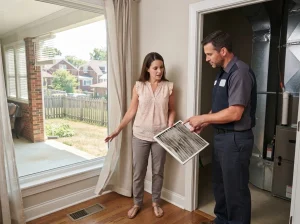
Why Air Conditioners Fail During Pittsburgh Heat Waves
Air Conditioning · 3 min
 You may hear a lot of advice over the years on how to boost efficiency and performance for your air conditioner. Some of this advice is worth listening to—investing in professional maintenance for your cooling system, changing your air filter every 1-3 months, clearing out the space surrounding your outdoor unit—and some is, well, not.
For instance, have you ever heard from an HVAC “professional” that your air conditioner’s refrigerant is something that needs to be refilled on a routine basis? Unfortunately, they may be telling you this because either they actually believe this is the case—meaning they aren’t actually a trained and experienced professional—or they’re trying to get more money from you.
The one AC myth you should never believe is that your refrigerant needs to be refilled, what we call recharged, every maintenance session. Read on to learn what’s wrong with this concept!
Refrigerant is the chemical blend that flows through your cooling system and actually makes the cooling process possible. Central air conditioning systems, heat pumps, and ductless HVAC systems all use refrigerant.
Many homeowners believe that refrigerant works like a fuel, like gasoline in a car that has to be replaced when it runs out. In reality, however, refrigerant is the fluid that makes heat transfer possible. Without it, the air conditioner won’t be able to actually cool the air it’s returning into your home.
Your air conditioner is supplied with enough refrigerant upon manufacturing to last the system’s entire lifespan. Unless that refrigerant is not charged the way it should be to begin with, there should never be a need to replace it. If your air conditioner is losing refrigerant, it’s a sign of a problem with your air conditioner.
If you’re ever told that you need to have your air conditioner’s refrigerant recharged, be sure to ask your technician the reason why. If it isn’t because of a manufacturer error, then it’s due to a leak!
Leaks can occur anywhere that your refrigerant runs through, including the refrigerant lines, evaporator coil, or the condenser coil.
They often start as small, pinhole leaks, and are very hard for the average homeowner to spot. It’s typically something to listen for and feel for, rather than look for. A refrigerant leak will often make a hissing or bubbling noise as the gas or liquid leaves your system. When a refrigerant leak goes on long enough, it will result in a loss of cooling power from your system. It will also lead to:
Call the friendly staff at Boehmer Heating & Cooling for exceptional customer service! We’re your trusted resource for Pittsburgh AC services.
Air Conditioning · 3 min

Air Conditioning · 3 min

Air Conditioning · 3 min
Very reasonably priced and on time
- Mike Meerkat
Do we serve your neighborhood?


 412-381-4100